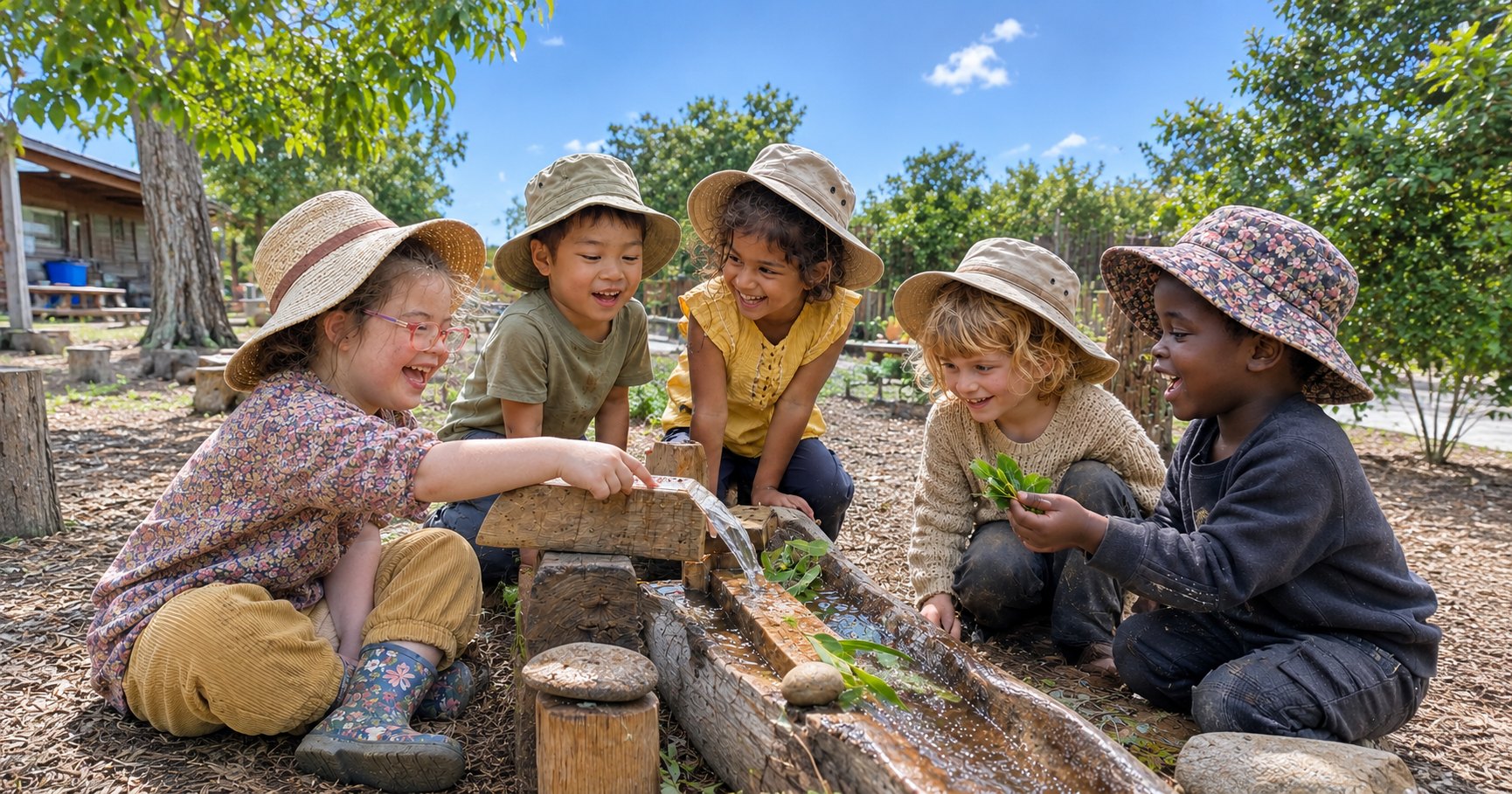
It's pick-up on a Friday. A parent zips a jacket, hunts for a hat and asks the question we all get asked: "So what did she learn today?"
The true answer is that she played. For most of the morning she and two friends tried to get water to run uphill in the sandpit, failed, argued about why, and tried again with a longer pipe. But "she played" feels thin when you say it out loud, so we reach for something that sounds more like school. We mention the letters at group time.
Today, 20 November, is World Children's Day. The date marks the United Nations adopting the Declaration of the Rights of the Child in 1959 and the Convention on the Rights of the Child in 1989. Article 31 of that Convention gives every child the right to rest, leisure and play. Article 3 says a child's best interests must be a primary consideration in decisions that affect them. And in Australia, since 27 February 2026, the National Law has made the safety, rights and best interests of children the paramount consideration for everyone involved in running an education and care service, from the approved provider to the student on placement.
So play is a right the child holds under the Convention. Separately, our own law now names children's safety, rights and best interests as what comes first. That law doesn't mention play or set an amount of it. What it gives us is a reason to ask where play sits when we plan a day. Children first, always, has to include their play.
| Applies to | Educators, early childhood teachers, room leaders, educational leaders, directors and approved providers in services under the National Quality Framework. |
| Jurisdiction | National. The Convention is an international agreement Australia has signed up to. The paramount consideration is in the Education and Care Services National Law. The Early Years Learning Framework applies across Australia; Victorian services also use the VEYLDF. ACECQA notes that New South Wales has its own amended provisions, so NSW services should check their regulator's guidance. |
| Checked | 20 November 2026. |
Why does play so often come last?
Nobody in early childhood is against play. It loses anyway, a little at a time, to things that feel more urgent.
Families worry about school and want to see something that looks like preparation. Routines cut the morning into pieces: morning tea, nappies, sunscreen, pack away, group time. Documentation asks us to stop the play so we can record it. A planned experience has a product to finish by eleven, so the block tower that was going somewhere gets packed up.
Look down that list and every item is an adult need. A parent's reassurance, our timetable, our records, our plan. None of them is unreasonable. If we say children first, here is a question to ask ourselves: when an adult need and a child's play want the same half hour, which one usually gets it?
The UN Committee on the Rights of the Child saw this coming. In 2013 it wrote a general comment on Article 31 because, in its words, of the "poor recognition given by States" to these rights. It warned that early childhood education was increasingly focused on academic targets and formal learning, at the cost of play. That was written about the whole world. Most of us could name a room it describes.
What counts as play?
The Committee's definition is tighter than the one we tend to use. Play is behaviour that children themselves start, control and structure. Adults can set up the place for it, but the play is voluntary and done for its own sake. The Committee lists its marks as fun, uncertainty, challenge, flexibility and non-productivity.
Play doesn't have to produce anything. An activity where every child makes the same paper plate animal can be enjoyable and worth doing, but an adult started it and an adult decided when it was finished. A quick test for any moment in the day: who began this, and who is allowed to end it?
The Early Years Learning Framework sits comfortably with that. Version 2.0 names play-based learning and intentionality as one of its practices, and describes play-based learning as "a context and a process for learning" in which children make sense of their social worlds. It also says intentionality belongs to children as well as educators. A child who decides the pipe needs to be longer is acting with intent.
What does play do for children?
- Health, confidence and getting along. The Committee's general comment calls play essential to children's health and wellbeing. It says play builds creativity, imagination and self-confidence along with physical, social, cognitive and emotional skills, and that through it children learn to negotiate, sort out conflict and manage their feelings.
- Self-regulation and the skills behind learning. In 2018 the American Academy of Pediatrics published a clinical report, The Power of Play. Its authors concluded that play with parents and peers promotes the social, emotional, cognitive, language and self-regulation skills that build executive function: the ability to hold a goal in mind and ignore distractions. They also describe play as a buffer when children are living with serious stress.
- Early maths and flexible thinking. A team at the University of Cambridge pooled the research on guided play, where children lead and an adult gently steers toward something worth learning. They reviewed 39 studies and combined 17 of them, covering about 3,900 children aged one to eight. Guided play did better than direct instruction for early maths, shape knowledge and switching between tasks. For the other outcomes they did not find a difference either way. The work was funded by the LEGO Foundation, and the studies defined guided play in different ways, so read it as good evidence with limits.
- Every child. The Australian Education Research Organisation reviewed the evidence in 2025. It reports a link between educators supporting learning through play on purpose and how children do, and says intentional educators matter particularly for children experiencing disadvantage. It is also frank that the evidence has gaps.
Children learn well in play they own, with a thoughtful adult close by.
There is a catch in arguing this way, though. Every time we defend play by listing what it produces, we accept that play has to earn its place. A right doesn't. A four-year-old lying in the grass doing nothing in particular is using Article 31 exactly as written, because it covers rest and leisure too. The benefits are real and families deserve to hear them. But she has the right either way.
What does children first, always look like on Monday?
- Find your longest stretch. For one week, notice the longest time children in your room played without an adult stopping them. This isn't a score. Just look at what broke it.
- Ask whose need it is. Before you call pack-away or pull a child out for a planned experience, ask whether the interruption serves the child or the timetable. Sometimes the timetable has to win. It helps to know when that is what happened.
- Join as a player. Sit down in the play. Offer one honest question or one new material ("what if the pipe was longer?") and then hand it back. That is guided play, the kind the Cambridge review looked at.
- Write it up afterwards. Let the play finish, then document it. A learning story written at rest time about the water that wouldn't run uphill loses nothing, and the children keep their morning.
- Change the pick-up answer. Say what happened and then what it was. "She spent forty minutes working out why water won't run uphill. That's testing an idea, and it's her working with two other children to do it." It gives a family something better than a worksheet to take home.
- Protect doing nothing. Rest and leisure are in the same article as play. Let the child watching the clouds keep watching.
Where does this get hard?
Families' worries about school are real and deserve a proper answer. The Cambridge findings on early maths are a useful thing to share, and so is a look at what their child did in play this week.
Some children need help to get into play. A child with disability, a child who is new, or a child still learning English may stand at the edge for a long time. The Committee names groups whose right to play needs particular attention, among them children with disabilities, girls and children living in poverty. Children first has to mean every child, so the educator's job is to open the door and then give the play back.
Safety is part of the same duty. Play that carries some risk is still play. Active supervision continues through all of it, and your service's risk assessment and supervision plan decide how it happens.
And the day still has to run. Children need to eat, sleep and be changed, yards are shared, and ratios are what they are. Nobody can hand a room four clear hours. What most rooms can do is find one interruption a day that didn't need to happen.
If you want the wording of the paramount consideration or the EYLF practice in front of you for a team meeting, you can ask the Knowledge Engine and it will show its sources. Our Great Read on children's agency looks at who controls the clock, and the EYLF outcomes guide sets out the five outcomes.
A question to take back to your room
If you asked a child in your room tonight what the best part of her day was, would it be something she chose?
Sources
- United Nations, Convention on the Rights of the Child (1989), Articles 3 and 31, and World Children's Day.
- UN Committee on the Rights of the Child (2013), General Comment No. 17 on the right of the child to rest, leisure, play, recreational activities, cultural life and the arts (article 31).
- ACECQA (February 2026), Information sheet: Understanding paramount consideration.
- Australian Government Department of Education (2022), Belonging, Being and Becoming: The Early Years Learning Framework for Australia (V2.0).
- ACECQA, Information sheet: EYLF Practices, Play-based learning and intentionality (Early Years Learning Framework V2.0, 2022).
- Yogman, M., Garner, A., Hutchinson, J., Hirsh-Pasek, K. and Golinkoff, R. M. (2018), The power of play: a pediatric role in enhancing development in young children, Pediatrics, 142(3), e20182058. doi.org/10.1542/peds.2018-2058
- Skene, K., O'Farrelly, C. M., Byrne, E. M., Kirby, N., Stevens, E. C. and Ramchandani, P. G. (2022), Can guidance during play enhance children's learning and development in educational contexts? A systematic review and meta-analysis, Child Development, 93(4), 1162 to 1180. Free full text.
- Australian Education Research Organisation (2025), Play-based learning with intentionality (discussion paper).
Please read: This article is general information and Ask ECE's point of view, written to help educators think about their own practice. It is not legal advice and it can't take your service's situation into account. Follow your service's policies, risk assessments and supervision plans, and check the National Law and Regulations and your regulatory authority's guidance before you change them. Sources checked 20 November 2026.